Wednesday, June 8, 2011

Death by PowerPoint


Last year after I presented at the UMB Ed Tech conference, I checked the Twitter feed and discovered a number of very complimentary and emboldening tweets.  But one (isn't this how it always is?) has always bothered me, mostly because I discovered it to be true.  It claimed that my presentation was "Death by PowerPoint."  Well, if you aren't afraid of dying via digital slides, you might want to check out the screen capture of the session I ran with my students, Christine Sands, Kate Unruh, and Adam Overbay during this year's conference.    As I noted in my last post, I blogged about this presentation earlier, so if you fear redundancy, don't click the link.  In any case, I thought I'd share it with you to see if you had any thoughts about the presentation, be they about the content of the presentation, the presentation style, or the use and abuse of PowerPoint.  I'm not happy with my use of slides, but I really like to avoid handouts when I can.  If for no other reason, I would suggest checking it out to hear from some brilliant students!   

Monday, May 9, 2011

Time Travel and Romance

At the end of this week I will be participating in two conference sessions.  The first one is on blogging and role playing at UMB's Center for the Improvement of Teaching / Educational Technology Conference.  You might be wondering why the conference title is exceptionally long - it's the result of the merger of two conferences.  The CIT conference was scheduled for earlier this year, but was postponed by one of the many massive snowstorms we had this year in the Northeast.  You may recall that I blogged about my anticipated (but alas canceled) presentation with my students here.  After this second-chance presentation (fingers crossed) on Thursday morning, I will hop on a plane to Kalamazoo for the 46th International Congress on Medieval Studies.  There on Friday morning I will be presenting in a session sponsored by the Medieval Romance Society called "Traveling Texts: Adaptation of Medieval Romance."  I'm still tweaking this talk a bit, so I thought I'd share the text of it here.  Please let me know what you think!

Thursday, March 31, 2011

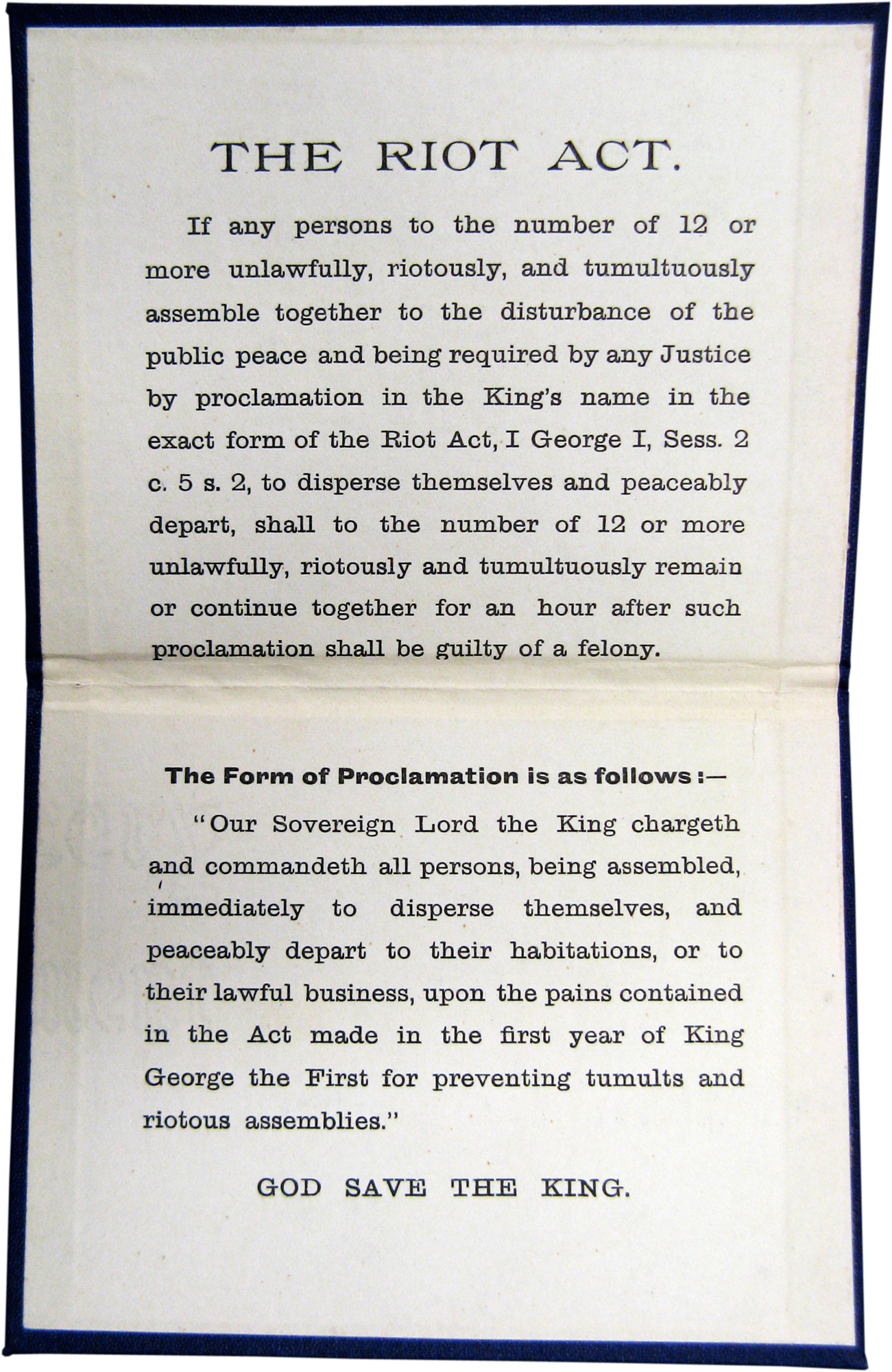
Reading the Riot Act

Wikimedia Commons: booklet from the
University of Reading
Sometimes the Atlantic Ocean can be such a nuisance.  If only we could take a quick T ride across the pond to check out the British Library exhibit,  Evolving English: One Language, Many Voices, we could witness the origins of the English language as they are represented in texts such as the Anglo-Saxon Chronicle, dialect recordings, and even "The Riot Act."  Dr. K pointed this out to me, and in checking our the exhibition, I also discovered the site's blog, which is definitely worth checking out.  Apparently, they have been posting the results of an ongoing "Map Your Voice" project, which encourages readers to record their voices onto a worldwide and interactive map of English.  A recent blog post lists a number of interesting pronunciation of words that differ from those recorded in the OED such as "controversy," "garage," "neither," "scone" (I've always wondered about this one!), "schedule," and "attitude."  "Schedule" is one of those words that I've always thought offered a clear distinction between U.S. (skedule) and U.K. (shedule) English, but apparently the U.S. pronunciation is beginning to gain some ground on the U.K. one.  Here's the explanation the blog offers:

"The OED distinguishes between 'shed' as a British English pronunciation and 'sked' as American English. Not surprisingly, then, all the North American voices use 'sked'. However, 25 out of 60 British and Irish speakers agree, while 35 out of 60 prefer 'shed'. We might, therefore, interpret this as evidence of recent influence from US English, but there could be other factors, e.g. the subconscious spelling association with similar words likescheme, school etc. which are clearly 'sk' for all speakers. It’s certainly plausible to imagine that schedule is first encountered in its written form rather than as a spoken form (I don’t imagine it’s a very high frequency word for young children), but perhaps there is indeed American influence at play, too."


Do we Americans have to take over everything, even people's schedules?  I would encourage all of us to check this out and contribute if we have a moment.

Thursday, March 3, 2011

Want to be a Wikipedian?

Wikipedia as a printed book?
Just the other day I received the Fall 2010 issue of Studies in Medieval and Renaissance Teaching (SMART), which contained an essay I wrote called "Wikipedia as Imago Mundi."  The material should be familiar to those of you who know my interest in Wikipedia as a digital form of premodern collaborative knowledge production.  When I wrote this for SMART, I worried about the fate of an article about digital textuality in an exclusively printed journal, but as it turns out, my fears were unfounded!  Last night I received a kind e-mail from a reader of the article, who is not just a teacher of HEL, but also an active Wikipedian.  He informed me that he had already spread the word about my article to Wikipedia:Talk, which potentially expanded my audience a billion-fold (at least).  Moreover, he informed me about an active community of Wikipedians who serve as campus ambassadors about the proper use of Wikipedia.  I encourage you to check it out.  In any case, I find the generosity of this Wikipedian and the speed by which my article achieved a digital life to be incredibly telling about the effectiveness and efficiency of this form of knowledge sharing.

Tuesday, February 1, 2011

Commuting with the City Mouse

Steinhöwel's woodcut, Basel, 1501  
The following is the product of my most recent thinking regarding my new project tentatively titled, Veni, Vidi, Wiki: A Prehistory of Digital Textuality.  I'll be presenting this paper at UMass Boston's Research Center for Urban Cultural History (RCUCH) in a couple weeks and would love to workshop this a bit beforehand.

I think this paper speaks to concerns of our group, particularly the effects that the limits of textual environments have on discourse communities.  So please comment!

Here's the abstract (aka short version) if you don't have the patience for the rest:

Commuting with the City Mouse: Aesop's Fables and Academic Commentary

The instant message poses a formidable threat to literary interpretation.  While texting may contribute to recent demands for abbreviation, the desire for the instant message predates digital technology and has long plagued teachers' attempts to cultivate extended conversations about classroom texts.  The common readerly attraction to singularity and brevity often belies the interpretive multiplicity necessary for academic dialogue.  Perhaps no genre fully satisfies this appetite for the message more than the Aesopic fable.  Each brief fable is accompanied by a concise moral that readers can easily consume.  Yet, fabular interpretation has not always been so digestible.  In the fourteenth and fifteenth centuries throughout Europe, Aesop's fables were standard classroom texts that offered more than a kernel of moral advice.  As staples of grammar and composition instruction, readers paraphrased and elaborated upon the fables in extensive commentaries, which served as medieval hypertexts that subsequent readers could read, associate with other classroom texts, and extend through marginal and interlineal glosses.  The medieval fable then offered the opportunity for practice in literary elaboration and collaborative constructions of knowledge, a far cry from the instant message we have to come to associate with Aesopica.  Furthermore, this model of medieval fabular reading is based on the same principles as user-friendly digital environments such as blogs and wikis, within which commentary can be produced at an unprecedented rate.  This paper suggests that these modes of digital elaboration and dialogue recall and remediate medieval fabular reading and writing practices.  While the restrictions of print culture reduced and often eliminated commentary, the digital network drastically expands the field of interpretation for literary texts.   In particular, the wiki offers a cyberspace within which students and teachers can compile commentary about course texts outside of the classroom.  Most importantly, the inscription of classroom dialogue onto this digital palimpsest can mitigate the challenges of maintaining cohesive academic communities on a commuter campus such as UMass Boston.  As a new form of fable commentary, wiki-writing can attenuate the desire for the instant message and develop a new respect for the virtues of collaborative elaboration.

Saturday, January 1, 2011

I don't mean to avunculize, but . . .


Dr. K just sent me this fun link to the "save the words" movement organized by Oxford Dictionaries.  For word nerds like us, this is a great interactive resource that jovially suggests ways to keep obscure words from ending up in the lexicographic dustbin.  A couple of my favorites are the cute "jobler," one who does small jobs, and "gleimous," a synonym for "slimy" that would be perfect for Tolkien's Gollum.  My least favorite, for obvious reasons to those of you who know me, is "magistricide," the killing of a teacher.  It makes me feel acrasial (look it up).

Happy New Year!    

Wednesday, December 15, 2010

Arthur's Two Historiographies in Alliterative Romance


Before I'm overwhelmed by a massive student paper deluge, I thought I'd try to draft my paper for the "Biopolitics" session organized by the Arthurian Literature Discussion Group for the upcoming MLA convention in Los Angeles held during the first week in January.  As I was working my way through this, I realized how HELish it really is (hopefully without the second "l"!).  My reading of Sir Gawain and the Green Knight, in particular, explores the meanings and histories of enigmatic words in the prologue such as "winn" (could mean "strife" or "joy") and "depreced" (could mean "conquer" or "release").  If you have any suggestions or comments I would love to read them.